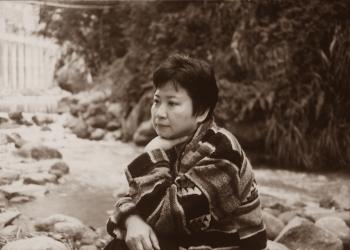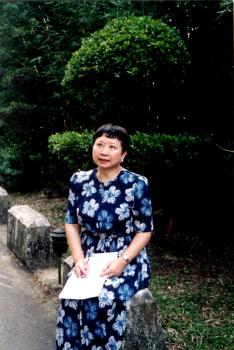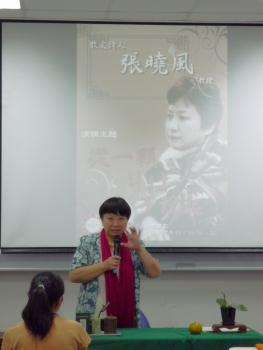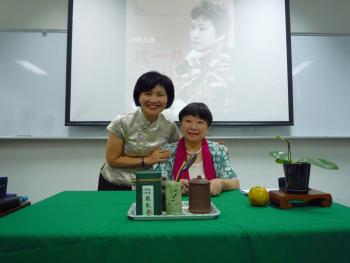

Chang Hsiao-feng is one of the most celebrated writers in Taiwan today. Her essays and poems have delighted, soothed and inspired the Chinese-speaking world for decades. What most people don’t realize is that in the early 1960s she taught for a time at ICLP (then the Stanford Center).
Chang took the job at ICLP job not knowing quite what to expect from American students. She had graduated not long before and was working as a teaching assistant at Soochow University. "A friend convinced me to do it,” she joked. At a time when Chinese as a second language had yet to become so popular, teaching Americans students entailed some surprises. Chang recalls her surprise at having to explain aspects of everyday Chinese culture—a paper lantern, for instance. The year was 1962; there was no Wikipedia.
The proactive classroom demeanor of her American students also came as a challenge at first. She recalls that the experience helped her learn how to better share her passion for Chinese literature will all sorts of students. For instance most recently, Chang teaches at Yang-Ming University, a top medical college. She hopes to impart upon the physicians-in-training a humanism that will be useful when caring for patients. She also fondly remembers reading Lu Xun in ICLP’s library, one of the few uncensored in Taiwan at the time.
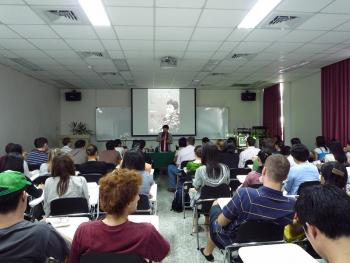
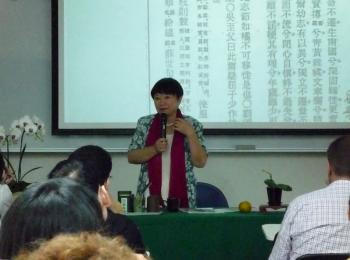
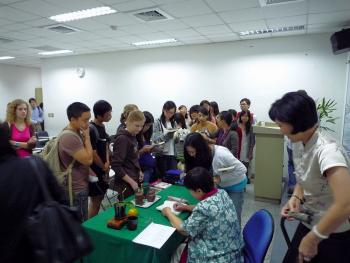
On October 9, Chang Hsiao-feng returned to ICLP to deliver a lecture, “從一顆ㄐㄩˊ子說起” (The Talk Starts with a T-A-N-G-E-R-I-N-E), about the citrus’s role in Chinese literature. Chang touched upon everything from filial piety to ancient highways. She shared the insights about Chinese culture and the life of Chinese people in centuries past that she has gleaned from decades of informal research of the tangerine in literature. The lecture was a treat for those who find more traditional narratives of Chinese history—with their emphasis on politics and war—difficult to approach.
Many advanced students at ICLP first encounter Chang’s work when studying Contemporary Short Stories from Taiwan. Included in the text is her short story “The Clock,” which described the trials of a school teacher sent to work in rural Taiwan. Many of her more notable pieces are complied in the anthology 《曉風吹起》(Xiao3 Feng1 Chui1qi3).
Over the next five issues, the ICLP Bulletin will serialize Chang’s new short story 《打來打去》 (Da3lai2 Da3qu4). Originally commissioned by the children’s section of the Mandarin Daily News (國語日報), the story contains many humorous use of the word 打 (da3), making it great review for students of any level trying to grasp the full meaning of this verb. We will include a bilingual glossary with pinyin.
Even students with only a few years of Chinese training may find Chang’s fluid, natural style quite accessible. The author herself hopes to share her appreciation of beauty with as many as possible.