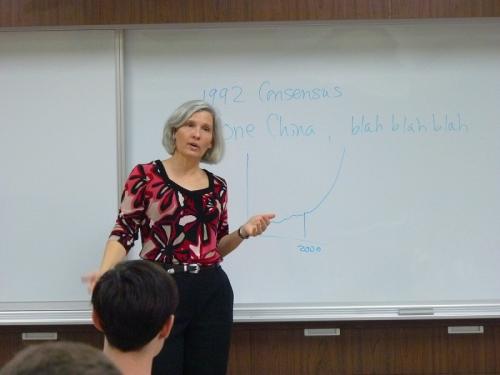
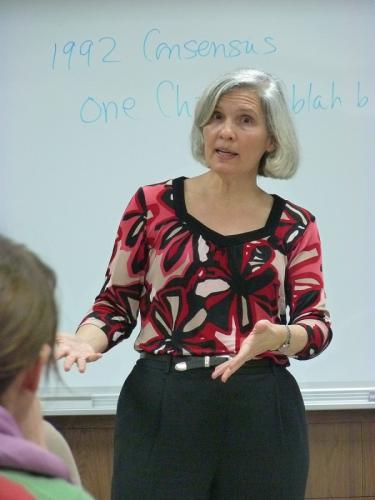
Dr. Shelley Rigger, a noted expert on Taiwanese politics, gave a talk at ICLP on Monday, January 9. Her talk discussed the then upcoming presidential and legislative election, and included a discussion of U.S. and mainland Chinese perspectives on the election. Dr. Rigger is the Brown Professor of East Asian Politics and Chair of Political Science at Davidson College in North Carolina. She is also the author of Why Taiwan Matters: Small Island, Global Powerhouse.
Dr. Rigger consults regularly with senior U.S. officials about Taiwan. She said she was here to get a sense of what was going on with the election by talking to people involved with the political parties, political campaigns, think tanks, and academic organizations. "People back in the US are asking a lot of questions, and are very interested to know what is at stake in this election," she said.
She also noted that this election was another in a string of firsts for Taiwan, because it is the first time the legislature and the president have been elected on the same day. "This is actually a matter of some consequence," she said, because we tend to expect voters who don't like the president to look to the other party when voting for the legislature, and voters who don't like the legislature to look to the other party when voting for president. This time, however, "that kind of strategy is impossible...there is at least the possibility that this year's election may be a more kind of authentic statement of partisan preferences across both branches of the national government."
What follow are excerpts from both her talk and an interview with the ICLP Bulletin.
U.S. and Chinese Perspectives on the Election
Dr. Rigger was in Shanghai in December, where she spoke with scholars and officials, and said both U.S. and Chinese officials shared a desire to see President Ma re-elected.
"People believe that the preference of the U.S. government is for President Ma to be re-elected," Dr. Rigger noted, talking about contentions made by the Taiwanese press. She identified two data points used by people to support this contention: the fact that a U.S. National Security Council official called the Financial Times to say they were uncomfortable with Tsai Ing-wen, and Taiwan's recent addition to the list of countries queued up for visa-free entry to the U.S. She said she thought these data points were weak, but also said, "I think it's beyond obvious that the US government would like to see the status quo in the Taiwan strait continue, with status quo including a Ma presidency, because the last 4 years, or the last 3.5 years, have been far easier for US officials dealing with cross-strait relations and Taiwan policy than the previous 8 years when a DPP president, Chen Shui-bian, was in office."
With respect to the Chinese view, she said Chinese officials have a "strong desire to see Ma re-elected," but noted Chinese officials have to be careful about expressing support for fear that it may result in Taiwanese voters doing the opposite of what China wants.
"The Chinese officials that I've talked to seem to have a strong preference for giving this message to people like me--to deliver on their behalf--to people in Taiwan, and people in the U.S, than to actually deliver this message themselves. And in fact, for the last 12 years almost, we have been under pressure, that is to say, not just American officials but also civilians like me, have been under pressure from our friends in China to use our leverage over Taiwan and Taiwan's citizens to get them to ‘be good,' which is to say comply with the preferences of the Chinese Communist Party leadership."
"This is not a particularly effective strategy, both because Americans are often resistant to comply, and also because we don't actually have that much leverage or influence anyway. Coming out clearly in favor of Ma would certainly, the Chinese leadership has come to understand, hurt his chances of being re-elected," she continued. "Rather than to heap praise on President Ma, they have chosen to heap criticism on his opponent."
She also discussed the threats the Chinese leadership made regarding what would happen if Tsai Ing-wen had been elected.
"Will they deliver on these threats? I don't know. But what they want us to understand is that what we should anticipate is a comprehensive withdrawal from the broad spectrum of cooperative activities that have come into being during the last four years of the Ma presidency, if Tsai is elected," she said.
The 1992 Consensus
Dr. Rigger also talked about the 1992 consensus, and said Tsai Ing-wen's rejection of it was the main reason why the PRC was uncomfortable with her candidacy. She described the 1992 consensus as the understanding that made decades of subsequent talks possible. It was an oral understanding, she said, in which both sides said they agree there should be one China: "In Taiwan, how that's understood is, one China, respective interpretations.... In the PRC, they don't actually buy into the respective interpretations, they're more into the one China part.""At any rate, this little fig leaf--and it is a tiny little fig leaf--has covered over this huge gulf in values and principles since 1992."
"What has created this perception, both in Washington and in Beijing, that Tsai Ing-wen is going to get in the way of continued progress on all of these things is that in the absence of the 1992 consensus, if Taiwan refuses to say the basis for our conversation is the '92 consensus, there is no backup that is acceptable."
Dr. Rigger also noted, "We have to remember, there could be a plan B, but the PRC government doesn't want one. There is a power play here, for sure. Insisting on the '92 consensus is a way for China to control the terms of the discussion.... But it might be worth it... in order to have the discussion."
Perspectives on President Ma and Cross-strait Relations
Dr. Rigger went on to discuss perspectives on President Ma and the current state of cross-strait relations. There are ways that you can kind of be uncomfortable with the degree to which cross-strait relations have warmed over the past 4 years, Dr. Rigger said.
If you're in the U.S. government, she said, you may be uncomfortable because you think that "Taiwan is not protecting its interests adequately; it's more a kind of incompetence or failure to appreciate the severity of a threat. Some people say Ma is not strong enough, or he's not aware enough, or he's not paying attention to the threat that Taiwan faces."
However, she noted, "Some people are not nervous at all, they see this direction as having a lot of upside and very little downside."
She also raised an issue that has been discussed by Robert G. Sutter, regarding what the U.S. should do if Taiwan decides to align with the PRC and not resist the kind of unification framework that the PRC is pushing. "That creates strategic challenges for the U.S.," she said.
Pre-Election Battles: Competing Economic and Cross-strait Perspectives and the Movement Toward Political Negotiations
Dr. Rigger also discussed comments made about the economy: "If that's what you want, prosperity, is there another way to get it, other than going through mainland China? I think that's what this election is really being fought over. Is there an alternative economic strategy. I think people want one. I think the DPP is saying it has one. The beef would be lacking, in my opinion. "
She also touched on Ma's policies. "Ma's policies are way more popular than Ma himself." She said Taiwanese had overly high expectations for his first term in office. "People just thought the man was going to fix it, all of it."
"A lot of why Ma has not solved all of Taiwan's problems is that Taiwan has a fundamental problem, is that it's trapped in the fjord, and it's not clear if there is an exit."
"Sometimes I think that it would be perfectly all right either way, and that there might actually be a certain kind of benefit if Tsai were elected, because I think one of the things that is becoming apparent to the people in Beijing is that they are not ready for progress toward political negotiations, because they don't know what they want. They're having a conversation, Tsai says Taiwan needs to have this Taiwan Consensus, and Beijing is talking about something they call One China Framework. These are both embryonic notions. The Taiwan Consensus, I think the ideas is that it means, that everyone is going to sit down and decide what they want together.... It's perfectly obvious that there's a consensus for keeping things the way they are."
Dr. Rigger also mentioned Ma's first term pre-election pledges: no independence, no unification and no use of force, and said that Taiwanese found them very appealing: "Independence is incredibly costly. Unification? Why? What is in it for Taiwan? Armed conflict, don't want that. Maybe we could add one more thing, which is everybody gets rich. This is the Taiwan consensus." The challenge, of course, is delivering all of that, she said.
Interview with the ICLP Bulletin
President Ma's Discussion of a Peace Agreement
Question: Early in the campaign, President Ma discussed signing a peace agreement with the Chinese. What do you think about the proposal and the reaction to it?
Dr. Rigger said she believed that President Ma was indicating to the Chinese that he remembered that prior CCP-KMT talks had promised a peace agreement. Thinking that it would also be acceptable or even desirable to Taiwanese voters, he was testing the waters, she said. He quickly learned that it was seen as a significant change to the widely popular status quo. She said the reaction in mainland China was also negative, because officials were concerned about it damaging Ma's chances of re-election success.
Chinese Leadership Changes and Taiwan
Question: Mainland China is also going through a leadership transition right now. How do you think that affects the cross-straits situation?
Dr. Rigger said, "One thing that I think is very evident is that the coincidence of this election with the transition in the mainland is greatly increasing the level of anxiety around Taiwan policy in the PRC."
"The way they talk about that, or at least the way they talk about that with me, is that if Ma is not re-elected, Hu Jintao's strategy... the enemies of Hu Jintao will call this a failure of his policy."
"The Taiwan experts in the PRC like the current policy, they think in the long run it will work, or it will meet China's needs."
"They're really worried that the hardliners will get a leg up on the sort of more patient voices within the Chinese leadership if Tsai is elected."
"I'm totally of two minds on this whole election. On the one hand, it makes me very nervous to think about... the stuff they're threatening Taiwan with is serious, [it] would hurt.... On the other hand, though, I kind of think it might be good for everybody to have a little time out, and if Tsai were elected there would be a time out. ... On the other other hand, would they spend that time thinking how to be more patient and accommodating, ... or would they spend that time out thinking about ways to hammer Taiwan down.... either way there's risks for Taiwan, because Taiwan is in a difficult position and has been for a long time."
Can the Status Quo be Maintained?
Question: Do you think the status quo can be maintained indefinitely?
Dr. Rigger said, "It's really up to the Chinese whether they would tolerate it or not.... I think the idea of a marriage of equals is the best Taiwan is ever going to get, other than the preservation of the status quo, failing some kind of catastrophe in China that you just don't want... Because there is something worse than a rising China, an imploding, exploding, falling apart China is worse."
"Failing the collapse of the PRC, which I think is really unlikely, I think the best Taiwan can get is to continue the status quo, and if that doesn't work, then the best they can get is this kind of marriage of equals which is purely symbolic but leaves Taiwan with its political autonomy truly intact. It's very hard to imagine the details of that arrangement... how that would work in practice, but lots of things are hard to imagine.... I think the status quo is sustainable for awhile. But I'm also not at all sure that there will not come a time when the people in this country say, we'll take a marriage of equals, some kind of symbolic unification, in order to end the possibility of something far worse."
Foreign Policy and Military Issues in the Region
Question: How does all of this tie in with the recent increased American interest in the Asia Pacific region?
Dr. Rigger said, "The Chinese government has always insisted they have no interest in stationing troops in Taiwan. The idea that--if you believe them--the idea that Taiwan would be sort of a forward presence in the regional security apparatus--we don't need to worry about that. But any kind of unification would probably neutralize Taiwan as a forward presence for the U.S. in a kind of containment arc."
"And then you have to raise the question, is containment a sensible policy for the U.S.? Is containment necessary for the U.S. to preserve its core interests, which is, I think, avoiding being counter-contained, contained out of the region?"
"I don't think the U.S. needs to control north and southeast Asia, but I think the U.S. needs to have access. And I think the other countries... want the U.S. to have access, because they actually, because of the tyranny of geography, they fear China more than they fear the U.S."
"The Vietnamese are more afraid of China today then they are of the U.S."
"I think the U.S. wants to be there [in the Asia Pacific region], and it will be there in part because it's wanted by the other countries in the region. How important Taiwan is for that presence, I think is a matter of a debate."
"Chinese foreign policy thinkers tell themselves a story, which is that we are different. The Western countries and Japan rose through violence, power, colonization, and various strategies of control of other peoples. China doesn't do that."
"On the one hand, they want to make the argument that China is different, and that China is not rising in order to impose itself on others. At the same time, they're IR realists, they are John Mearsheimer's most devoted disciples. They believe that power drives international interactions... they're offensive realists. What they want to say is that nobody needs to be afraid of China, because China is different, but that China must be afraid of others, because the others are playing this realist power game. But what happens as a result of that is that China, in responding to the power plays of others, has only this little bikini of an ideology story, standing between its own musculature and much smaller weaker neighbors, who say we don't believe your fairy tale about China being different, we think you're growing this giant military for the same reason the Japanese grew their giant military in the 1920s. The thing that is supposed to make China nonthreatening is rhetoric, and that just doesn't take you anywhere. The thing that makes the U.S. nonthreatening is that there's no reason for the U.S. to menace these countries, anymore, and you look at the logic of it and say the U.S. is not dangerous, and China is. So, I think they're really in a tight spot."
"And then, I think the even more interesting contradiction is that the Chinese government, the Chinese military, in order to accomplish certain goals, needs to become more capable, but the more capable it becomes, the more it threatens its neighbors, and the more it threatens its neighbors, the more they call in the U.S. as backup. Or, if they can't call in the U.S. as backup, they work on their own capabilities. So no matter what China does, if it tries to drive the U.S. out, it creates a security dilemma with Japan, if it tries to drive Japan out, it creates a security dilemma with the US.... in other words, challenging the status quo for China creates these really negative dynamics, and that seems to be something there's just no way out of, because the only thing that China has to offer as a reason why you shouldn't react by beefing up your own military in response to their military modernization, is this fairy tale that China is different from other countries, and why would anybody believe that?"
U.S. Arms Sales to Taiwan
Question: What do you think about what went on with the recent arms sales to Taiwan?
Dr. Rigger said, "I think the U.S. is really trying to balance meeting the defense needs of Taiwan and not provoking the PRC more than necessary. Taiwan doesn't always get everything it wants, but the PRC doesn't get what it wants either, which is no more arms sales."
"One element of all of this that needs to be kept in mind, too, is that Taiwan's government has not allocated nearly enough money to complete the purchases of weapons that the U.S. has already agreed to sell. The whole Chen administration was just a complete disaster on the arms sales front. President Bush in April 2001 [said] basically, we're going to sell you everything you ever asked for, almost, and then it got tied up in the Legislative Yuan for the entirety of Chen Shui-bian's term. Now, we sort of think it's no longer tied up in the Legislative Yuan, except that it kind of is, because while they say they want to buy it now, they don't appropriate the money."
"So I can understand why you might say, you know what, I'll sell you something that you might actually buy, instead of offering you something that's going to get me in a huge deep pile of it with Beijing [that the Taiwanese might not actually buy anyway]."
"It's a little bit of politics, it's a little bit of how serious are the Taiwanese about their defense, but it's a lot of, seriously, we'll sell you the stuff that you really need, if you'll buy it."
"We've gotta show them the love, but they've got to show us the money."