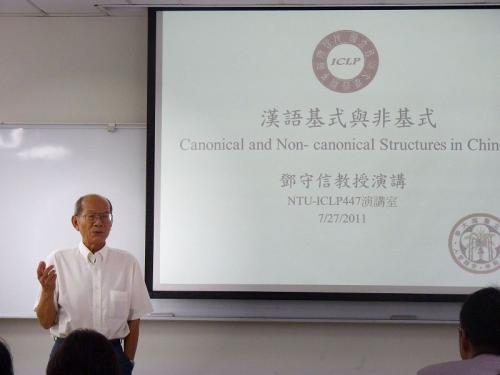
On July 27, 2011, I had the honor and privilege of listening to Professor Teng, Shou-Hsin lecture to ICLP teachers on canonical and non-canonical structures in Chinese. I was first introduced to his seminal work during a "Chinese Grammar" class I took with Chen Li-Yuan Laoshi two semesters ago at ICLP. At that time I was very frustrated with my progress in Chinese. Although I was classified as an advanced Chinese language learner, I felt insecure in my ability to correctly use newly-acquired vocabulary. For years I was told that "Chinese really didn't have grammar" or that "Chinese grammar was easy because you didn't have any verb conjugations." I was told to worry about producing accurate tones and memorizing characters rather than Chinese grammar. According to my teachers, "Chinese grammar" was something I would just "get" over time. The problem is that after years of studying Chinese, I never really got "it," but learned to fake "it" pretty damn well.
In the past, whenever I used a word incorrectly in class, I was almost never given a coherent grammatical explanation - more often than not, I was simply told, "That's not how we say it in Chinese." In lieu of a grammatical explanation, the teacher would simply give me three or four different examples showing the correct usages of the word, and I would try my best to remember these examples. As a result I never truly felt confident about using new vocabulary words outside the textbook usage. I always dreaded the part in Chinese class when the teacher would call upon students to use the vocabulary word in a new sentence - this part of class always felt a little bit like playing Russian Roulette, sometimes you got lucky and sometimes you didn't (in which case the "correct examples" of how to use the word would come marching out).
Having studied isiZulu and Arabic, languages as difficult to master as Chinese, I found it curious that teachers of these languages could provide clear grammatical explanations, while most of my former Chinese teachers could not. Something did not seem right. However, early on it was pounded into my brain (with a certain amount of smugness) that the study of Chinese simply could not be compared to that of any other language because Chinese was "special, " "unique" and "different." While never entirely comfortable nor satisfied with this explanation, in the end I accepted it as truth, gritted my teeth and kept pushing. However, after studying two semesters of Chinese at ICLP, I began seeing holes in the "Chinese is special" argument, especially as I saw ICLP administrators and teachers working hard to implement a new Chinese language pedagogy very different from that used by my former Chinese language teachers. Rather than emphasizing the "uniqueness" of Chinese, this new Chinese language pedagogy drew upon the work of Professor Teng, Shou-Hsin who used Noam Chomsky's theories on Universal Grammar as a tool to examine and correct problems plaguing traditional Chinese language pedagogy. I found his research so fascinating that I made it my mission to learn more about the revolution slowly taking place at ICLP during my third semester at ICLP.
Professor Teng, Shou-Hsin believes that the duty of the Chinese language instructor is to not simply provide students with an abundance of random language data, but to provide them with the correct language data so that they are able to grasp the rules governing different Chinese grammar concepts and understand how these concepts connect to simple "universal grammar" principles. To illustrate this point, Professor Teng, Shou-Hsin explained how native speakers of English learned and over time corrected their understanding of the rule governing the "past tense" verb form. For example, early on linguists noted that children around three years old generated the verb "go+ed" as an "My mom goed to the store." In the field of linguistics, "go+ed" is considered a universal error. While "goed" is ungrammatical, the formation of this verb demonstrated that the child had both begun the process of sorting through all of the linguistic input they had received thus far and the process of formulating a rule to create "past tense" verbs in English. When children reached four-years-old, linguists noted that "goed" had in most cases been replaced by "went." The child's understanding of the rule governing the creation of past tense verbs had been modified to accommodate this irregular past tense form. Professor Teng, Shou-Hsin specially mentioned this example to show the importance of an apt language data set during the language acquisition process. If native speakers of English had been given 200 verbs with "ed" endings, they too would never have understood the canonical structure of the "past tense" in English. Likewise, Professor Teng, Shou-Hsin believes that the goal of the Chinese language teacher is not to provide vast amounts random of language data to students in the classroom, but to give students an apt language data than enables them to grasp the canonical structure of the grammar concept being taught.
After years of feeling like I was being thrown random language data in my Chinese classes, it was a relief hearing from a professor who finally understood the root of my uneasiness who had a solution. While listening to Professor Teng, Shou-Hsin lecture, it was moving to see the rapt expression on the faces of the ICLP teachers. I could see that they truly cared about making sure that ICLP maintained its status as a forerunner in Chinese language instruction. As his lecture drew to a close, I very much got the feeling that Professor Teng, Shou-Hsin came to ICLP not so much to explain his views on teaching Chinese as a foreign language - most everyone present already seemed familiar with his theories - but rather as a type of parental figure. His goal was simple and direct: help teachers who still clung to traditional Chinese language pedagogies see the errors in their ways and encourage those teachers who had already seen the "pedagogical light" to keep marching forward.