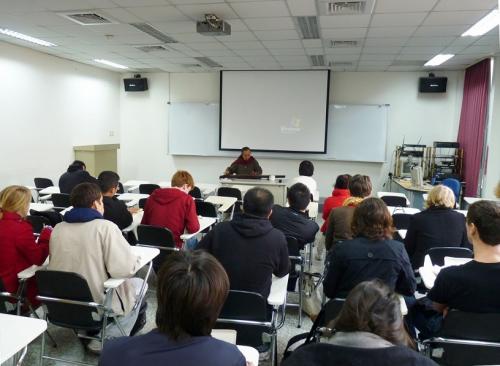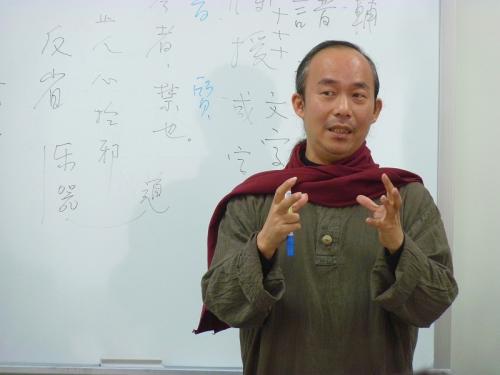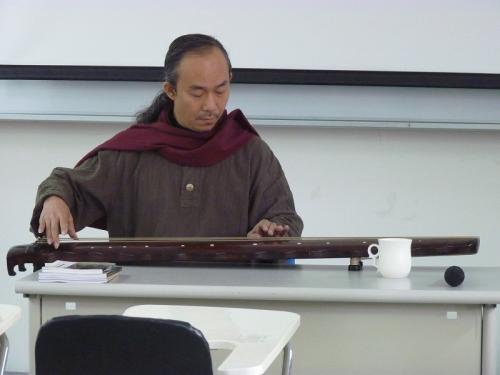
Students and teachers at ICLP enjoyed an opportunity to learn more about an underappreciated art form last week when local guqin player Ma Junguo came for a well-received performance and lecture. After opening with a brief live performance, the Malaysian-born artist went on to explain the philosophy and history behind his instrument, as well as illuminate a few practical curiosities regarding the instrument.
Ostensibly dating to the very beginning of Chinese civilization, the instrument has a documented history of at least 2,000 years and while less popular today than it once was, maintains an active community of practitioners. According to Ma, there are more than 1,000 pieces in existence which have been performed continuously until modern times. Because of the characteristics of guqin notation, a teacher’s example is crucial for any student wishing to learn a new piece. Unlike modern Western musical notation, traditional guqin notation does not indicate notes or rhythm, but instead delineates finger position and technique. A student practicing a piece will sit facing his teacher and imitate his performance, sometimes for months or even years, before developing a full understanding of how to translate the written notation into a fully-fledged performance.
Ma illustrated traditional guqin notation with examples of the two most common types, excluding twentieth-century attempts to adapt Western staff notation: wenzi pu and jianzi pu. The first, illustrated in this case by a Tang-era piece, is written out entirely in ordinary Chinese characters describing how to play a piece. Jianzi pu, allegedly invented by Cao Rou in the late Tang dynasty, streamlines older notation by incorporating the most important information into entirely new characters describing each sound. Following this innovation, in the Ming dynasty more and more pieces began to be gathered into tablature collections for distribution and study.
Beyond practical considerations of notation and performance, however, Ma was most interested in helping the audience understand the philosophical underpinnings of the instrument. Deeply rooted in Chinese intellectual culture, the guqin has been a favorite of many important historical figures and scholars, from philosophers and poets like Confucius and Li Bai to the Three Kingdoms general Zhu Geliang. Ma jokingly asserted that it has been “strange” people who have been most attracted to the instrument; people who, while capable of studying existing performances, have strong thoughts and feelings of their own which they are capable of expressing in their performance. As he said, the first stage in learning any piece is to be able to imitate your teacher perfectly. The second, and more important stage, however, is imbuing your performance with your own unique viewpoint. Ironically, and contrary to common notions of a dearth of Chinese creativity, the sparse notation employed by Chinese guqin players means that there is a great deal of space within each piece for individual experimentation.
Ultimately, the process of perfecting one’s own performance of any piece, according to Ma, requires a spirit of calm self-criticism and continual adjustment until the player is expressing his or her feelings as clearly as possible. This process is perhaps the origin of the famous phrase extolling the moral value of the qin: “The qin is restraint; restraint of the bad in order to correct one’s heart.” Although it sounds harsh, it is that spirit of continual refinement and self-improvement which can give so much pleasure in artistic expression. Ma’s performance and story amply illustrate this point.