“When I first joined the company,” the dancer said, “They took me to a large, quiet room and asked me to practice sitting still. Then they left me there. I sat and I sat and I sat and I sat and I sat and then I was so exhausted I slept until lunch.
“After days of sitting, kneeling, standing, and sleeping, I got to practice some moves. It wasn’t like any training I’d had before, but not because it was complicated. I was repeating movements I’d made my entire life without thinking. I had to open and close my hand, turn my head, bow, reach out, or step backward, over and over again. I couldn’t leave the room until I could do those things beautifully.”
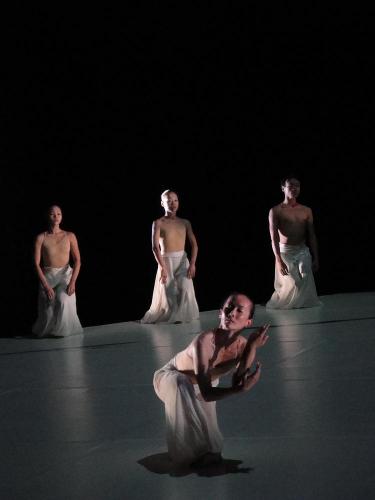
The curtain rose. The set was a blank canvas. The dancers were wearing white costumes so minimalist they didn’t seem like clothing. The BGM was slow and primeval, like sound before there was music. The few dancers on stage were moving more slowly than kabuki performers. At first, they were simply shifting weight.
This anti-grand opening worked. The usual noises of fidgeting and crinkling plastic were nowhere to be heard in the audience. I wanted to write this in my notes, but I didn’t want to disturb anyone, so I pulled my pen and paper out of my pocket inch by inch. When I clicked my pen open, I worried that it reverberated from the upper deck to the stage.
The company was doing the same thing to the audience that it does to its trainees: clearing their thoughts. I squirmed. I’m used to doing three things at once and having three more errands in mind, then forgetting three hours later what I was doing at the time. When I want a break, I don’t get away from it all: I get myself distracted. This time, I entrusted my attention to the dance. I scribbled in the dark while looking at the stage so I wouldn’t miss anything, though it rendered a third of my notes illegible.
That night’s program was named Water Stains on the Wall. Its inspiration is this conversation (copied from the performance program) between two master calligraphers of the eighth century:
Yen Chen-ching: Where do you get the inspiration for your calligraphy? Huai Su: I observe summer clouds that resemble mountains with spectacular peaks. The most exciting parts remind one of birds flying out of woods and snakes slithering into bushes... Yen: How about water stains on the wall? Huai Su: Right on! You old devil! |
Newton’s Laws didn’t close the book on physics. There are patterns too complex for us to recreate with linear computer programs, like the trail of smoke from a cigarette. Water stains develop slowly and organically, and one goal of this piece is to artistically recreate that evolution and random beauty. The floor, at first blank, later illuminated like a screen: black flowed across it like ink, white like clouds. (The three walls had nothing on them.) The stage was tilted to increase the challenge and introduce variation to the movements, but there wasn’t a false step: my brain only registered peculiarity when dancers running offstage looked like they were going downhill.
Once my mind was clear, it saw the beauty of the dance. Even the simplest movements had elegance and rigor. It all seemed new. For a stretch there was only one woman on stage, and I was so attuned to her that when a man began to dance behind her, I was startled: it seemed like he appeared from nowhere.
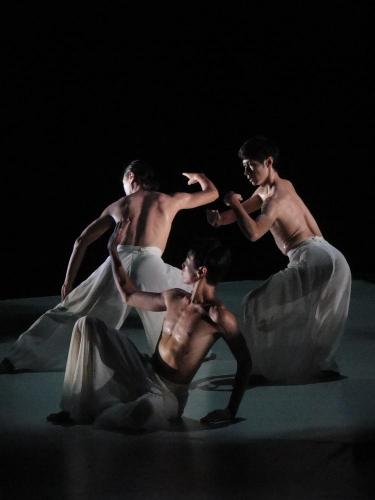
The pace wasn’t noh-slow forever. After the table was set, the dancers did a lot of running, jumping, gymnastics, and tai chi, sometimes in unison and sometimes individually. It was impressive to see eight people doing different things on stage without clashing with each other. They were as sharp in the last minute as they were when they began, a testament to their physical conditioning. The stage and score took active roles later on, as well, creating sunlight, storms, and a black hole on a single black and white surface.
The music was in the Zen tradition. One could call it creepy; it called up feelings I hadn’t had in a long time. The score’s strength was its softness: if it had pushed harder, I would have put up walls against it. It wasn’t dissonant for dissonance’s sake; rather, the notes aimed to harmonize not with each other but with my mental bass chords. The dancers’ feet added natural percussion.
There was a trace of a story with a woman defining herself and then proving herself to three men and a society, and the climax resembled a crisis and look into the void, but these were images, not arguments. It seemed like things just happened, like water stains. When the troupe exhausted the possibilities of one combination or tempo, they rearranged or change paced. I didn’t know how many performers or musical numbers there were until after the ending.
The program was just sixty minutes long, but the applause was satisfied and sustained. The dancers lined up in the back of the stage, took a step forward, and bowed. The audience wouldn’t stop, so the line stepped forward and bowed again, and in that fashion eventually reached the front, where appreciative choreographer and founder Lin Hwai-min joined them to huge plaudits. Finally, the dancers broke off in twos, and the curtain fell. I walked back to the station – clumsily, I thought, since I’d never studied how to walk, but briskly, because I was looking at the world differently.