
Where were you 2,561 days ago? It was October 2, 2003. A lot has changed since then, right?
Confucius was born 2,561 years ago, on September 28, 551 BC, according to tradition. He might be surprised we're still talking about him, because he never held a high position in the government himself. He once said to his friend Tse-Kung, "Alas! there is no one that knows me. I do not murmur against Heaven. I do not grumble against men. My studies lie low, and my penetration rises high. But there is Heaven - that knows me!" (Analects 14:35). He also said, "I will not be concerned at men's not knowing me; I will be concerned at my own want of ability" (14:30).
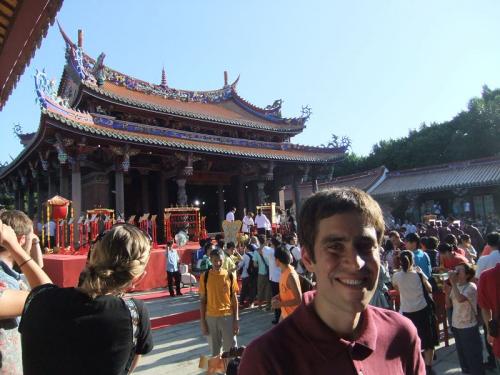
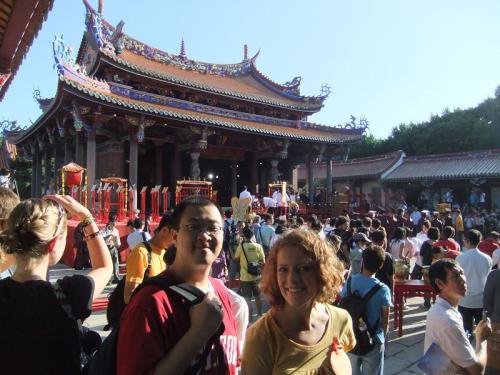
Since then, billions of people have heard his name, and over two million people count themselves as his descendants: we ICLP students are contemporaries of the 82nd generation of his family. On Tuesday, September 28, Confucian temples said prayers and made sacrifices in his honor. Eight ICLP students received entry passes for the 6:00 AM ritual service at Taipei Confucius Temple in Yuanshan. The second day of class is pretty early for scrambling one's brains with a 4:15 wake-up time, but surely the Master's memory is as long as his beard, and he'll bless us in return.
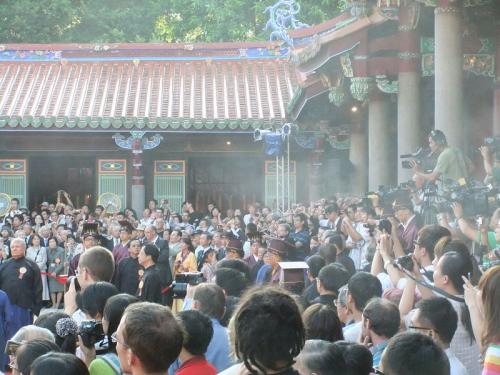
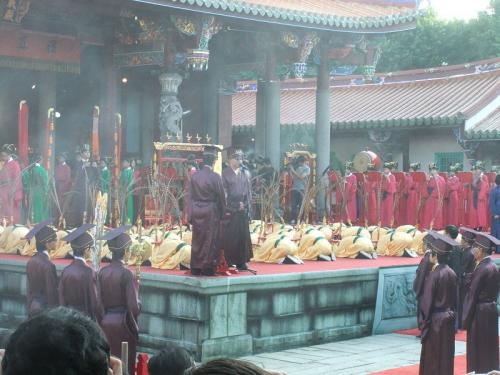
We arrived at the temple thirty minutes early. It was still dark, and there was already a long queue of somehow-energetic people. Inside the temple, there were only two concessions to modernity: the cameras in the hands of the TV crews and the eclectic few hundred lucky enough to attend, and the fans and mist machines which cooled off those who were packed together inside. The steady hum of the machines, and the resemblance of the mist to incense, made them seem particularly appropriate for the ceremony. They were certainly needed, because it was crowded - we'd call it standing room only if there had been any chairs - and the more time passed, the higher and hotter the sun became, as if it were Confucius illuminating, warming, and finally baking us.
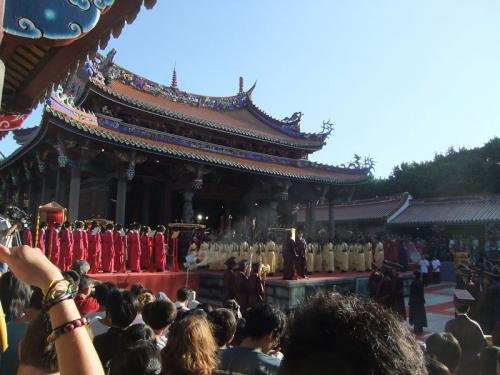
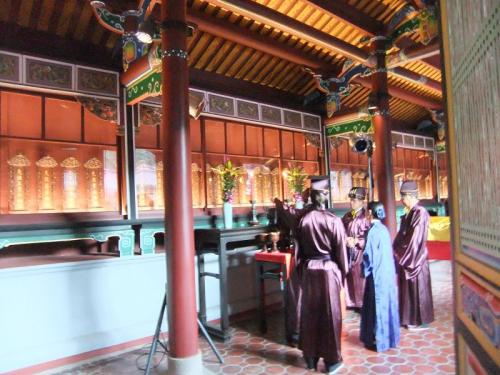
The service was immaculately performed, following a 38-point schedule and lasting exactly ninety minutes. About a hundred people, male and female, young and old, had roles in the ceremony, and they dressed in charming and colorful traditional robes and hats. The ceremony was carried out in the center of the temple square and inside the temple proper, and the congregation lined up around the walls. With the exception of the master of ceremonies, the priests and performers all faced away from the audience and towards the inner temple, drawing the audience's attention there as well.
The adults dressed in blue and purple robes performed the prayers and sacrifices which were made in all the parts of the temple. Their moved gracefully and acted deliberately. Dozens of students dressed in yellow danced, and dozens of students dressed in red played music, in the style used in the rituals of Confucius's time. This is exactly the sort of experience the master would have wanted youth to have: he thought traditional music and dance elevated the spirit, and he once said that the Shao music affected him so much that after he heard it on one journey, he did not notice the taste of meat for three months because he was still marveling upon what he had heard (7:14). The fan dances were graceful, and the music was performed with traditional wind and percussion instruments. While the melody was only eight notes, each time it was repeated, its emotional effect seemed stronger.
Not only the Mayor of Taipei but also the President of Taiwan, Ma Ying-jeou, attended the service. This would have pleased Confucius. He said of li (禮), his term for ritual and by extension for propriety, "To master oneself and return to li is humanity. If a man [the ruler] can for one day master himself and return to propriety, all under heaven will return to humanity. To practice humanity depends on oneself. Does it depend on others?"
The ceremony was the only ritual some people had attended all year, and the first Chinese ceremony some had attended in their lives. It's natural for people to gravitate toward the new, especially because modern entertainment is so fast-paced and exciting, but that day, Confucius and his disciples reminded us of the joy one can find in the old, in waking before sunrise and praying together with others where the only scent is incense and the only sounds are music and the humming of fans. Rituals are not flashy, but because of that, one can participate no matter one's talents or background. At certain points in Confucius's service, we in the audience, even those who couldn't understand the words of the prayer at all, joined in them by bowing three times together. Rituals do not often change, and so when we take part in them, we are joined with our ancestors and descendants, joining a line that stretches to the past and the future, far beyond the horizon. The rituals Confucius implored his own contemporaries to remember have continued for millennia since, and they'll continue long after we're gone and forgotten, for as long as people cherish the Master's teachings.