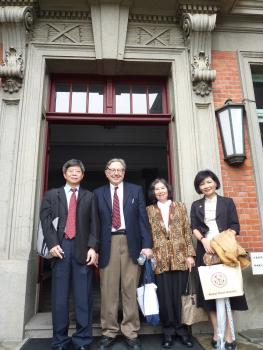
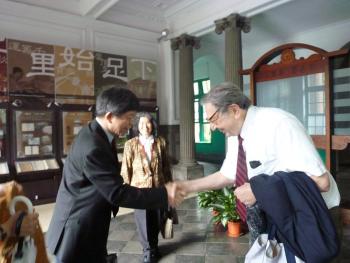
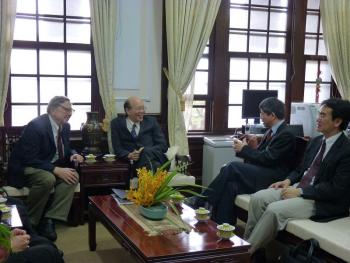
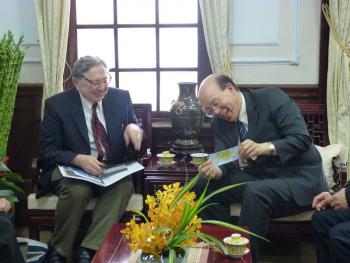
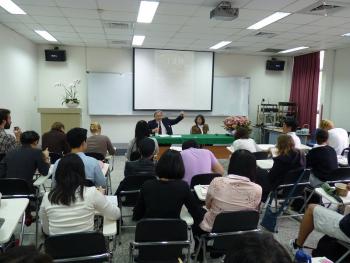
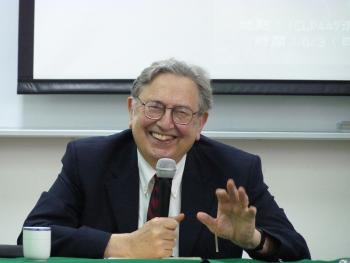
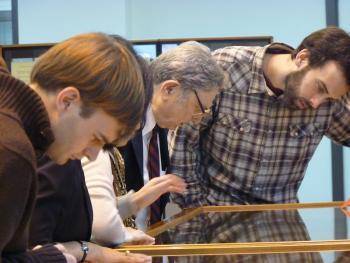
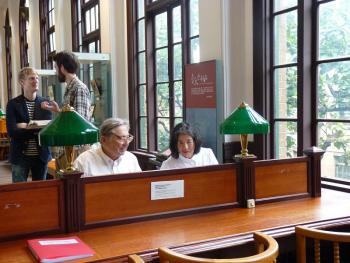
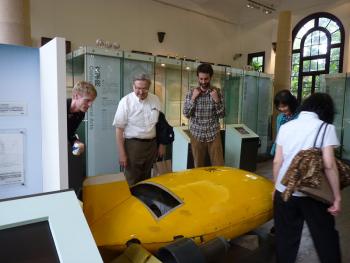
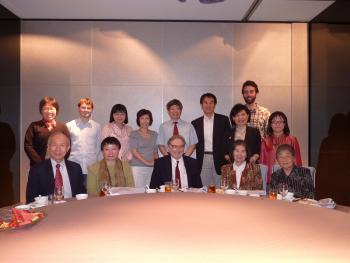
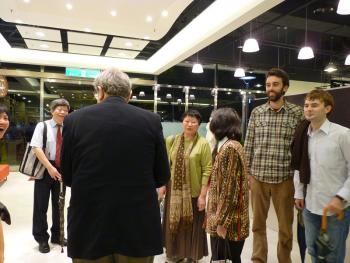
Professor Albert Dien, Stanford professor emeritus and the first director, returned to Taipei and toured ICLP on June 1. He spoke about his experiences as a student of Chinese and head of one of the earliest Chinese training programs in Taiwan. Professor Dien is now in his eighties and his speech offers a rare and truly vivid early account of the study of Chinese as a foreign language from a man who helped shape the field. What follows is a transcript.
First of all, I want to thank Prof. Leung Yanwing [ICLP director] and others for inviting me back to this campus where I spent a lot of time during my student days and afterwards. One very vivid memory is of the wonderful jiaozi [餃子, dumpling] restaurants across Luosifu lu [Roosevelt Road], I wonder if they are still there. I want also to congratulate those students who took the 離校測驗 (lixiao ceyan, exit exam) yesterday, I am sure you all did very well, and can feel proud of what you have accomplished this year.
I was told that this is to be an informal talk, and that given the stresses you have been under in these final days that an appropriate topic would be my own journey as a student of Chinese, and a bit of history about the founding of the Stanford Center program [ICLP’s predecessor]. It may well be that at the age of eighty-two it is time that I reflect a bit on what got me into this field. When people used to ask me why I was studying Chinese my usual response was that as an infant I must have been dropped on my head. Whether or not that in fact happened I do not know, but I think there were other more important factors. What comes to mind is the memory of being in the yard of my school in St. Louis at recess time when I was eight or nine and being told that if one dug straight down through the earth one would come out in China. I was also told then that China was where women wore trousers and men wore gowns. All of this was very strange and I realize now that it was the expansion of my horizon that made it something to ponder. You have to remember that there was no television back then, in the 1930s, and so one’s information about exotic places was exactly by such word of mouth source. Then, too, when I began collecting postage stamps about that time the Chinese stamps almost all had just the picture of man, the same face only in different colors depending on the denomination; it was a long time before I came to know this was Sun Yatsen the Father of his Country. So from an early age I was interested in far off places, something beyond the ordinary.
There was a radio program that I could listen to when I got back from school, each day a professor from Washington University in St. Louis spoke for fifteen minutes on his or her field (in those days I fear there were very few hers). The one I responded to was an archaeologist. As I said at that time there was no Discovery Channel, no National Geographic programs, no movies like Raiders of the Lost Ark and Indiana Jones. (Google movies and archaeology and you now get 1,830,000 results). You got your information on a hit or miss basis. That interest in archaeology surfaced very early. I remember as a kid digging in the soil under a kind of porch where we lived and came up with an adobe brick!
Then we heard the landlord coming and ran, but he saw what we had done and told my parents that if we did that again, we would have to move. There was no encouragement for such adventure. But still, in seventh grade I wanted to be an Egyptologist. I read parts of large volumes and took detailed notes, but without any larger vision. It was like trying to do a term on very limited topic.
In high school the focus of my interest shifted to Asia, as I remember it, for two reasons: one was the book March of the Barbarians by Harold Lamb, a thrilling story of the life of Chinghiz Khan and his conquests of Asia and Eastern Europe. I do not need to go into that. But the second was the translation by Mathew Arnold of the tragic Persian epic of Sohrab and Rostam, from the Shahnameh. Rostam, the great champion of the Persians did not know he had a son born of a Turkish princess. When the son, Sohrab grew up, also to become a mighty warrior, learned who his father was, he went to seek him. They came to do battle, neither knowing who the other was. They battled for days, neither able to conquer the other. Finally at one point, as Rostam let loose a blow, he shouted out his name, and Sohrab, startled that this was his father whom he had been seeking, dropped his guard and received a death wound. Even now I tear up when I read it. I remember drawing a map of that area, what is now Uzbekistan and Turkministan, locating the landmarks of the story and coloring in the various states. When I gave it to my sophomore English teacher, she had no idea what I was up to. While still in high school I bought a volume, G.N. Steiger, A History of the Far East (1936) and I became interested in India, in the great king Kanishka who established an empire succeeding the Greek state left over from Alexander the Great’s adventures in what is now Afghanistan, and so on.
At Washington University I could only take the usual courses. I knew someone who wanted to study Russian, and the dean said that if he found four others who were interested, they would offer the language. He could not find the required five! This was in 1944. I do remember seeing a journal in the library that included an article about the Chinese word di (帝); that the language was written with such a script looked interesting. Washington University in those days was not what it has become. Stultifying, no intellectual stimulation. So in 1945 I transferred to the University of Chicago; what a difference. In those days the university president was Robert Maynard Hutchins, who installed an innovative and pioneering program. I quote from a history of the university, “Hutchins focused on the highest abstractions—morals, values, the intellect…the ‘great conversation.’ ” The Great Book grew out of that milieu. It was exhilarating to be there. The first year I took Indian History, Sanskrit, and Indian Philosophy from a Prof. George Bobrinskoy (I found out in writing this that he was a Russian émigré count). The problem was that I was his only student in a number of classes, and it was hard to take notes as we sat facing each other, and I thought it impolite to look away. But Indian history soon paled. The Indians seemed to have no real interest in chronology. For example, there was much dispute about the dates of the great King Kanishka, ranging not over a year, but over what century he had reigned. Also, the sculptures of the busty women were embarrassing to me. So for the next two year at Chicago I switched to Chinese. My ultimate goal was Central Asia, and so with Sanskrit at one end, and Chinese at the other, I could move to study the area in between. I thought then that a couple of years of Chinese would do. So now, sixty-four years later, I am still struggling. I wish I could offer you a more hopeful message!
Studying Chinese at University of Chicago in those days was only classical Chinese by the so-called inductive method. That is, the belief was that there was no grammar, one simply read and read, and gradually it would come to make sense. Also since we were only reading, tones were not considered important. Instead we had to memorize as many as eight or ten definitions for each character, and had weekly quizzes. There were etymologies in the vocabulary section, not as mnemonic devices but these were to be taken seriously. For example that the character pifu de fu [the膚of皮膚] is made up of tiger [虎] and stomach [胃], was explained as the tiger hu tears the skin of his victim to put meat into his stomach. Our class devised a similar etymology for wu 無, a grill with fire under it, but nothing on the grill, so it means “nothing, without,” and going one better, if you touch the hot grill, you say “wu” so it has the sound as well. I did not get along with the professor, Herlee Creel, I do not want to speak ill of the dead, so I will only say that I decided to leave. At that time, there was no other Chinese language program that I knew of between the two coasts, so it was a choice between Berkeley and Harvard. A friend who had been in an army Chinese language school at Berkeley during the war, WWII, told me that Berkeley had a fine teacher, Peter Boodberg. What comes next shows the difference between then and now. I tore a piece of paper out of a note book and wrote in pencil that I wanted to come there to study. I got a letter back telling me to come on. So in 1948 I went to Berkeley. I had so little idea of California, I thought that between classes I could go down to the beach to swim. What I also did not know was that there was a feud between Creel and Boodberg over the nature of the Chinese written language, and when I found out, it suited me fine.
At that time there were no fellowships so one had to work. I had a few jobs, but it was a big improvement over Chicago, where I had been a night clerk in a seedy hotel, sold women’s shoes, was a busboy and whatever. UC’s tuition was very little, I think it was $50 a quarter for California residents, which I became even while attending the university. I was a TA for a year, and then began working in the library eventually becoming the reference librarian and in charge of the reading room. This was a half-time position, so I worked from noon to five, when the library closed; I stayed to do my studying, had the run of the whole library, and went home at two or three in the morning. There was no danger in those days being on the street that early. Then I slept until it was time to go back to work. It was ideal. The only problem was that I had to stop smoking because if Miss Huff, the librarian, caught me smoking in the library, that would have been the end. She was a real taskmaster and very strict, ran a tight ship, as it were.
In my first year at Berkeley, I took a course in Tibetan, and for Prof. Ferdinand Lessing, the Buddhologist, I did a paper comparing a Buddhist sutra in three languages, Chinese, Sanskrit and Tibetan. But Buddhism was not my cup of tea, and most of my work was with my Prof. Boodberg. All the faculty then were giants. Lessing, Boodberg, but also Y. R. Chao, a linguist and a genius, Chen Shih-hsing in literature, and later Mike Roger. So the years rolled by. There were no jobs and so there was no point in finishing up. I took all the courses offered and wrote a paper that I gave at a meeting in Seattle at the Western Branch of the American Oriental Society. There was a collection of the works of the Tang literatus Zhang Jiuling who among his other duties wrote intelligence reports for the emperor about the northern frontier where the Tujue, or Turks, were a problem. One of the reports mentioned that the Chinese had captured an i-du-kan who gave them some valuable information. I proposed that the transcription represented the Turkish idugan “female shaman, or shamaness” from the root iduq-“to descend from heaven.” We find the same root in the title of the ruler of the Uighurs, a Turkish speaking people of the 8th c. and on, iduqut. When the nomad Xianbei changed their surnames to Chinese ones, iduqan was changed to ming 明, so I have been arguing ever since that ming in terms like ming tang [明唐], or in mingqi [明器], the tomb burial goods, does not mean “bright objects” but numinous ones. Pro. Boodberg initially had doubts about my definition, because the great French Sinologist, Paul Pelliot, worked on Zhang Jiu-ling’s collection, and he would not have missed this. Years later, I discovered that the edition of the collection in the French library did not include this report, so my discovery was indeed serendipitous. Any rate, that paper was published in the Central Asiatic Journal, my first publication. It did wonders for my morale.
Before 1949, when the mainland fell, the usual pattern for advanced students of Chinese was to go to Beijing, find a tutor, read texts and learn to speak Chinese. But by 1956 it had become clear that the PRC was not going away, and a backlog of advanced students had built up. So the Ford Foundation, at the suggestion of Harold Shaddick of Cornell, decided to fund a program to send these people to Taiwan to study. A committee was formed, including Chen Shin-hsiang, Shaddick and Arthur Wright (who was then at Stanford). There may have been others; I do not remember. I was lucky enough to be chosen in the first group of five. These included Howard Levy, Catherine Stevens, Richard Howard, and Don Gillen, and myself. I remember that at the interview, when I was given to a piece of modern Chinese to read, I did not know that yaofan [要飯] meant beggar, I translated, “he wanted rice.” Still, they included me.
The first check arrived while I was in Berkeley. You have to realize this was the first time I had money in my pocket. It was exciting, to say the least. My first thing was to buy a pair of leather sandals that I had long coveted. I also paid to go back to St. Louis to say farewell to my parents, by a three day trip on a train, of course. I found a Japanese freighter by luck, that took me to Japan and I flew to Taiwan. It was on that ship, as we neared East Asia, and the radio picked up Chinese language programs that I began to realize I had a problem, I did not understand a word. Once in Taiwan, the idea was that we would spend the first month at Donghai University [東海大學], in Taichung, which had just opened. They tried their best, but the people in that program had no idea how to teach language. For example, the instructors had visited the US State Department language school in Taichung, and had observed that students there listened to newspaper articles being read to them, and then discussed the contents. So you can imagine how far I got when a newspaper was read to me. Perhaps I got somewhat off that hook by coming down with mumps, just at the time that the school doctor and nurse went off on summer vacation. I survived through the good offices of some of the staff there. I still remember that Ms. Cochran, a former missionary who taught English at Donghai, was convinced that boys caught the mumps from kissing girls. As far as I know, that was not so in my case.
Our group moved to Taipei in September where we were entrusted to a program at Shifan daxue [師範大學]. There was the same problem there: there was no already ongoing program. Despite some glitches, I was so fortunate in being assigned two Shih-da students who were superb tutors, Sheng Ching-heng (盛靜恆) and Yuan Nai-ying(袁乃瑛),both students at the university at the time. They both later came to the States, Ms. Sheng, married name Ma, at the University of Chicago and later Wesleyan, and Ms. Yuan at Princeton. I made some progress despite my poor ability to learn a foreign language. I owe my teachers and the school a great debt of gratitude.
Taipei at that time was very different from now. One could ride a bicycle from one end of the city to the other in a half-hour. It was full of wonders. My first night in Taipei I went for a walk and of course got lost. I ended up at what I later came to know as Yuanhuan [圓環], then full of small restaurant stalls. I remember seeing a young woman with a baby strapped to her back with a cloth wound in a complicated fashion; I stared trying to make out how it was done until her husband made threatening sounds. There was a billboard advertising a set of the standard histories, the Jen-shou edition that had just been published. I remember sitting in on a class on Mencius at Shih-ta, and I realized that in that one classroom there were more people reading Mencius than in the whole of the United States. But it did not escape my notice that it was a required course and the students were quite bored with its content. By the second year I began auditing classes here at Tai-ta, for example, a course on the histories taught by Li Tsung-tung, but other classes were not successful. The teachers often had such non-standard Mandarin. In one class taught by the famous historian Lao Kan, my classmate Howard Levy once raised his hand, which created an embarrassing moment. Students did not raise their hands, and Prof. Lao properly ignored Howard. His accent was particularly thick – I met him years later in the U.S. and still did not understand a word he said.
One event was very important to me. I had taken a course in Chinese historical linguistics from Y.R. Chao while I was in Berkeley. One night I went out walking with some friends and bumped into a few Taiwanese men, one of whom spoke Mandarin and offered to tell my fortune by reading my palm. He said I was a soldier and told me of my fortune. Most of the Americans in Taipei in those days were in the military and stationed at a place called Linkou [林口], this was during the period of the shelling of Quemoy [Kinmen 金門] and high tension in the Taiwan Straits. I told him I was not a soldier but a student. He turned to his companions and told them in Taiwanese that I was a hak-sieng [學生], that is xue-sheng [學生]. I knew xue [學] in Japanese was gaku [学], that is, that it had been in the ru-sheng [入聲, syllable ending in a stop consonate] in ancient Chinese. These are words that had endings in -p, -t or -k, which are lost in Mandarin. It was wonderful to me to realize that Taiwanese, like Cantonese, for example, had retained the ancient finals. So I determined to learn some Taiwanese. I eventually engaged a tutor, also a student at Shih-ta, but I was never an apt student, I am very slow with languages, and I solved the problem by asking her to marry me; last year we celebrated our 50th anniversary. I collected what Taiwanese-language material I could, including Japanese produced texts and dictionaries, and song books, guapo [歌譜], all of which I later donated to the library at Academia Sinica.
I was in Taiwan then for two and a half years, the first two with Ford grants and the last half I taught at the American school to earn enough money to buy a ticket to return to the States, I had spent all the money from the grants. I understand that money for return tickets was later withheld from grantees until it was time to return.
Teaching at the American school was an interesting experience. The students were mainly the children of the military stationed in Taiwan, and their social standing depended largely on the ranks of their fathers. The children made much of their being outside the culture around them, and what they looked forward to was a trip to Okinawa, where there was a big PX [Post Exchange, retail store operated by the military]. I taught ninth grade world history, and told them that the nineteenth century was that of Great Britain, the twentieth that of the US and twenty-first would be that of China. Parents came to me to complain that I was frightening their children. I had wanted to shake them up a bit, to unsettle their sense of superiority and I had succeeded a bit. What I had not realized is that my prediction could be more than a fancy. I also taught a course on Asian history, the first at the school. Meanwhile I had moved in with a Taiwanese family in a Japanese style house. My room was just big enough for a desk and bookcase; I had to put the chair on the desk to make room for the futon that I slept in. The other room in the house was larger, enough for the couple and their five children. The kids were darling, especially Gimei, then five, who would rush in to tell me the latest children’s rhyme she had just learned, and I duly recorded it.
Anyway I returned to Berkeley at the end of 1958. I was working as hard as I could on my dissertation, a study of a sixth century work. I supported myself with a job in a Mongolian dictionary project. There was only one Mongolian typewriter in the whole of the United States (this was before computers, you understand) and I typed the entry words on that typewriter. Someone else did the English and Cyrilic script. My fiancée came over in June, after she graduated from Shih-ta, and we had a year in Berkley while I continued to work on the dissertation. By then jobs were opening up as money from Ford began to make a difference. It was still quite nerve-wracking until I got a job at the University of Hawaii, half-time teaching and half-time as librarian of their Asian Library which was just opening. I was to teach beginning Chinese (my ten years of classical went for naught). The other teacher there, who had been there for years, was named Winters. She was Chinese but married to an American [hence the non-Chinese-sounding surname], while my name, Dien, looked Chinese, so the students all signed up for me, wanting to be taught Chinese by a native speaker. They were quite surprised on the first day of class. So, we divided the class into two. Two years later, Stanford decided to use some of the money that had become available to open a center in Taiwan, and I was hired to be the director. Even if I had hesitated, my wife would not have let me turn it down, she was homesick.
The Stanford Center was housed in the Freshman Building on this campus. There were some scary moments at the beginning. One student saw a quarrel between two cab drivers at the airport and decided China was not what she had imagined, and got on the next plane to return to the States. Would others follow? I was pretty much given carte-blanche for the ten or so students who remained. They were all first or second-year graduate students who had to do a Master’s thesis during the year to get their degree. I decided that they would read the whole of the Shui-hu-chun [水滸傳] and write their thesis on some aspect of the novel. A Tai-da graduate Chuang Yin was to teach that class, lecturing on it. The students read a page or two to start, increasing the amount each week, ultimately reaching a chapter a day; they finished it after two quarters and were to write the last quarter. To enable them to read that amount, I compiled a glossary of the novel (which I had not read myself until that point) keeping up with their schedule. Other classes were for spoken Chinese. Two of the teachers, Kao Kung-yi, now deceased, and Chuang Yin later came to teach at Stanford. By the time the year was over, those students were the only ones in the Unite States who had read a whole Chinese novel at their stage of study. I was pretty much kept chained to my desk to churn out the glossary, but it was an interesting time. You have to realize that Taiwan was very much in competition with the mainland and they valued the recognition then that the school represented. So my wife and I were feted and learned how much the higher officials, especially their wives, could down maotai [茅台, a kind of liquor] at banquets. I met some wonderful members of the Tai-da campus then. Shen Kang-po, one of the deans, was a strong supporter of the center, as was Tai Ching-nung, in the literature department, an accomplished calligrapher, and others.
The Cornell Program, by then in its sixth year, and housed in its own building, no longer at Shih-ta, had run its course. Perhaps Prof. Shaddick had decided to shuck the responsibility. But also, it had diverged from being primarily a language program to serving more as a tutoring one for those writing their dissertations. A consortium had formed, made up originally of representatives of eight universities, with Stanford taking the lead, and in 1963, the Cornell program was phased out, and I became the director of the Inter-University Program for Chinese Language Studies [ICLP’s direct predecessor]. Tai-ta was especially cooperative; a larger space was made available to us in what had been a Forestry Department building, as I remember. The program that I created there was based entirely on my experiences at Shih-ta six years before. The emphasis was on the spoken language, because of my conviction that the better one had a command of the spoken language, the better one could read. There was plenty of money those early years, so there was much individual instruction. We had a staff just dedicated to producing teaching material. One project was to analyze the xiaoxue keben [小學課本, elementary school textbooks], how many characters did the Chinese child learn in the first six years of school, at that time, and the extent of compulsory education. We found that there were 2,600 characters making up some 26,000 words, ci, [詞] and that over 90% of a newspaper editorial could be read with those 26,000 words, but that percentage dropped to about 60% for a college textbook. Anyway, I have always felt that these keben would be one of the best textbooks for the foreigner learning Chinese.
I returned to the States in 1964, and began a more traditional academic career. Two years at Stanford, two years at Columbia University, and then returned to Stanford until my retirement in 1993. I taught the classical language, early history, research methods, and developed courses on nomadic societies and the Silk Road. My focus in research has been the Six Dynasties, third to seventh centuries, and inner Asia. Most recently I have been studying the Sogdians, those people who came from Samarkand and Bukhara, in modern Uzbekistan, who dominated the Silk Road for a number of centuries; a number of their tombs have been uncovered recently in Xi’an [西安]. Last year I published an explanation of some reliefs on the sarcophagus of one of those Sogdians, and in the same issue of the journal a French scholar published his interpretation which was very different from mine—that dispute has yet to be settled but of course mine is the correct one! So I have studied the Sogdian language, and at present am working on Kharasahthi, the language used in documents on the southern Silk Road in the 3rd to 5th centuries. We are compiling a reader for it. I have become involved in the museum world. Last year I was guest curator of the exhibit of the Qin pottery army exhibit at the National Geographic gallery in Washington. I am currently writing essays for the catalogs of two exhibits, one that will take place at the University of Chicago and the other that was held at the University of Sydney, Australia. I am taking part in compiling a volume of translated selections of Six Dynasties literature, and am editor of a handbook on the sources for the study of the Six Dynasties period. I am also compiling a Chinese-English glossary of archaeological terminology, and preparing a paper on the Sogdians in China, on the question of assimilation or hybridity, that grows out of a conference this last spring at the University of Virginia. For that I want to explore what the field of ethno-archaeology has to offer. I have also been approached to be co-editor of the volume on the Six Dynasties to be included in the Cambridge History of China.
But the point is that all of this grew out of those precious years that I spent in Taiwan as a student. Without them, I might well have left the field because there were so few career opportunities for someone with the kind of training I had received up to that point. For all of that I am very grateful.