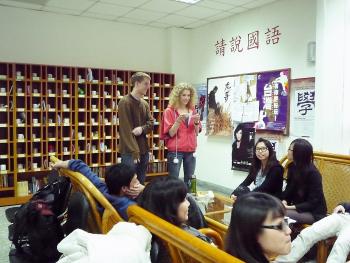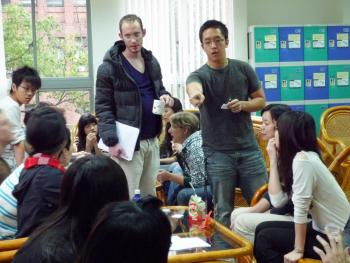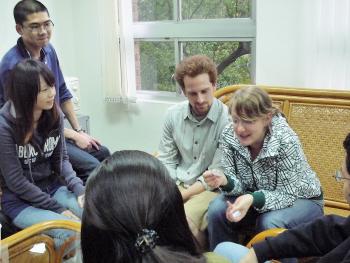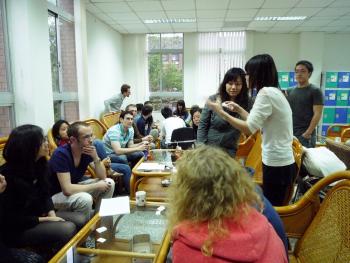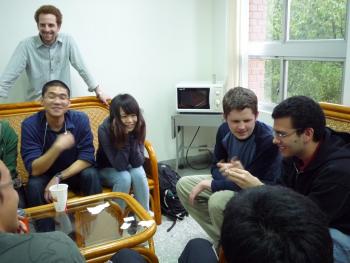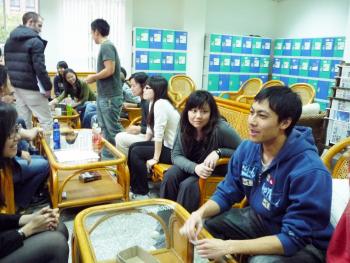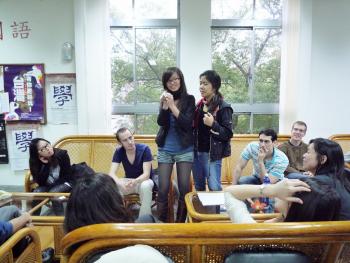
On March 5th of winter quarter, a group of ICLP students met with Director Leung’s the Media English class for the first time to discuss our plans to hold a weekly group language exchange. Since then, every Friday at 4:30 pm, the ICLP Lounge has been filled with a mad mix of Chinese and English chattering, storytelling, and joking. It has become a weekly event now where fellow NTU students will meet with ICLP students in order to put their learned language to practical use.
All of the students at ICLP came to Taiwan with a common objective: to learn Chinese. ICLP provides an expansive range of resources and teachers to accommodate students at various levels. Indeed, by the time students leave the program, many of them are proficient enough in Chinese to discuss topics varying from economics, politics, history, literature, sciences, and more. There is no doubt that ICLP excels at improving the Chinese proficiency of the students that enter its halls. That said, since first quarter, I have heard a gripe among many of my classmates: it’s hard to make close Taiwanese friends—a sentiment that I can sympathize with. Furthermore, some classmates can understand the news or explain the background behind a Tang poem, yet they have found it difficult to keep up with colloquial everyday Chinese in conversation. On top of the inevitable language barrier, there are also cultural differences, disparity in socializing habits, and the self-consciousness that many feel when applying a learned language to a social situation. Furthermore, ICLP’s homework load is no walk in the park, and the same can be said for the students at NTU, Taiwan’s top university. Unless you are already connected within the community, part of a local organization or club, or especially extroverted, it requires sacrifice and plenty of initiative to really break that barrier.
The group language exchange was founded in the spirit of creating a space that minimizes that barrier. Each week, there is a topic of conversation. So far we have talked about socializing habits, shopping, childhood stories and jokes. The exchange is separated into several activities. First, the entire group is broken up into smaller groups of four to six people, so people can interact on a more personal level. Everyone in each group gets to know one another through self-introduction in their learned language. Second is a warm-up activity, where an icebreaker or game is played, switching every five minutes between English and Chinese. There are plenty of opportunities during the activity to pick up new sayings or vocabulary. Activities have ranged from story chaining to taboo and storytelling. Third is the open discussion, where a list of discussion questions are provided, also switching between English and Chinese every five minutes during the discussion. This is where many of the vocabulary and sayings from the previous activity come into play. Finally, the last ten minutes are spent correcting mistakes, fixing pronunciations, and recording vocabulary or sayings from the activities.
I enjoy organizing the activity, because the atmosphere is very laid back; there is no pressure. Because the participants view the language exchange as an opportunity for learning, we have all been more willing to try new things, make mistakes, learn from them, and ask questions. The topics we choose are issues the common person discusses with friends, but not so often in class. Examples of questions we have discussed:
• Describe a perfect night out with friends.
• What were your dreams as a child? Have you changed or realized any of those dreams?
• How do you tell someone they have food stuck between their teeth?
• What do you do when you’ve forgotten the name of someone you’re talking to?
• What is the funniest joke you’ve heard recently?
Thus far, we have definitely gotten more familiar and comfortable with one another. There have been plenty of laughs and interesting discussions. Every time, we have ended up staying past when the activity is over, many still caught up in conversation. In that respect, the language exchange has been a rousing success.
That said, there are plans for more challenging and exciting activities to come. Among them, playing bilingual Mafia, improvisation, giving complicated directions, gossiping in Chinese/English and slang. The language exchange serves as not only an opportunity to practice much of the Chinese ICLP students have learned in class, but also as an opportunity to learn Chinese that is not taught in class, as well as getting to know fellow Taiwanese students.
For those interested in attending the language exchange, we meet every Friday from 4:30 pm to 5:30 pm.
 |  |  |
 |  |  |
 |