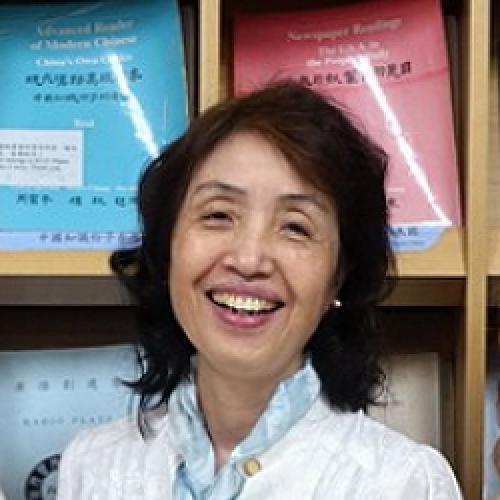
翻譯:尹子然(Translated by Ryan Matthew Hintzman)

資料來源;1980年畢業紀念冊(臺大圖書館藏)
Source: The 1980 Graduation Yearbook (Photo Credits: NTU Library)
七號館,一棟兩層樓和風的木造綠漆建築;輕步行在走廊的地板上,整個長廊都發出吱吱唧唧的回音;「史丹佛中心」裡面有好多金髮碧眼的外國人,校園中非常奇異獨特的一方洋場。這是一個初入臺大文學院書院女留下的印象,青澀年紀時我不曾想像許多年之後將參與其中的華語教學事業。校園裡七號館的建築已經消失,淹沒於現在共同教室的現址,樓前成排的橄欖樹,每年仍定時結果,見證它曾經存在。然而不廢江河萬古流,歷史不容淹滅,這是為什麼同仁與我一心一體,歷經兩年多的時間,在灰燼中撿拾珍珠,爬梳自IUP到ICLP的史料,企圖拼湊出華語教學在臺灣與臺大五十五年的傳承脈絡。
Building No. 7: a two-story wooden building in the Japanese architectural style, painted green; walking softly along its long passageways, the entire corridor would be alive with creaks and echoes; the Stanford Center, home to foreign students of fair hair and fair complexion; a singular and enchanting cosmopolitan quarter of National Taiwan University’s campus. All these are the impressions that remain years later, the impressions of a young female undergraduate who, having just matriculated to NTU’s College of Liberal Arts, never imagined that she, a number of years in the future, would be involved with the Center’s project of teaching Chinese as a foreign language. Building No. 7 is no more, having disappeared in the flow of time beneath a building that now houses general education classrooms; the rows of olive trees that stood in front of the old building continue to bear fruit year after year, attesting to the building’s enduring presence. But, in the words of the poet Du Fu, “nothing will stop the great river that flows on forever”; history must not be submerged, and therefore my colleagues and I have for more than two years gathered pearls from out among the ashes, combing through years of documents spanning the entire history of the Inter-University Program and the International Chinese Language Program, attempting to piece together and chart out the fifty-five-year unbroken tradition of Chinese language teaching in Taiwan and on National Taiwan University’s campus.
一九六二年美國史丹福大學中國文化研習所成立,校址設於臺大新生大樓三樓。一九六三年康乃爾、哈佛、哥倫比亞、普林斯頓、密西根、加州大學柏克萊分校、華盛頓和史丹佛等八所大學成立「美國各大學中國語文聯合研習所」(Inter-University Program for Chinese Language Studies;IUP),次年耶魯大學加入;同年十月遷址至臺大七號館。從IUP到ICLP一脈相承,我們堅持以領說為主,一對一,手把手師徒式的教學模式,培養出無數歐美漢學家,外交、軍事人員,學者專家等友臺人士。半個世紀後的十月二十七日我們假臺大總圖書館特藏區舉辦特展與論壇,慶祝國際華語研習所(ICLP)成立五十五週年暨IUP納入臺灣大學後的二十週年。我們並將初步整理完成的第一手豐富史料全數贈予臺大總圖書館典藏,留待有心人在現有的基礎之上再接再厲,繼續補強、梳理、探索、詮釋,甚至修史作傳。
In 1962, Stanford University’s Chinese Cultural Studies Institute - known informally as the “Stanford Center” – was established; the program was initially housed on the third floor of NTU’s Freshmen Building. In 1963, Cornell University, Harvard University, Columbia University, Princeton University, University of California Berkeley, Washington University and Stanford University jointly established the Inter-University Program for Chinese Language Studies (IUP); the following year, Yale University joined the board and the program moved to Building No. 7. From the program’s beginnings as IUP through its current incarnation as ICLP, we have emphasized oral training in the Chinese language, one-on-one instruction, and building close relationships between students and teachers. Using these pedagogical methods, we have trained countless leading Sinologists from Europe and North America, as well as diplomats, military personnel, professionals, and other friends of Taiwan. After more than half a century of Chinese language teaching, on October 27th, at NTU Library’s Special Collections Room and auditorium we will host an exhibition and a forum to celebrate the 55th anniversary of ICLP and to celebrate 20 years of ICLP’s incorporation into National Taiwan University. We will also be donating the materials we have gathered to NTU’s library collection, awaiting future researchers who will build upon the present foundation and continue to comb through, explore, and decipher ICLP’s archives. We hope that they will continue to write and pass down ICLP’s history.
個人有感於華語研習所歷史的縱深與二戰及韓戰後美國對華政策緊密相連,衷心感佩美華前輩先賢的奉獻;華語教學早已超越語言本身,華語教師成為漢語文字/文化圈的推手,而使海內存知己,天涯有知音。個人面對所史大事年表,無以計數的枝節片段拼貼出的圖象,彷彿看見灰燼中鳳凰浴火重生。我對參與所史整理工作的伙伴們感激不盡。所史年表中記載,「1963年校址設於臺大;臺大象徵性收取一年一美元租金」;「1963年設置專門信箱收寄匪偽書刊,為臺灣少數進口該類書刊之學術機構」。當年稱中國大陸的出版品為匪偽書刊,七號館的禁書區在戒嚴封閉的年代為校園提供一隅自由開放的閱覽空間,華洋共處的環境開啟所內師生的國際(含中國)視野。為此,我向半生受教、執教的母校台灣大學,謙卑致敬。
I find myself moved by the depth of ICLP’s history, and by the close link between ICLP’s own history and that of Sino-American relations in the post-war era; I feel deep gratitude for the contributions of my predecessors, both American and Taiwanese, in my role as ICLP Director. It is clear to us that Chinese language teaching has long since been about more than the Chinese language, and has become a driving force in the promotion of Chinese culture and letters; to paraphrase Wang Bo, the Tang Dynasty poet, “when one makes friends at home, one has friends in distant places.” When I look at the chronology of events in ICLP’s history, with its innumerable episodes, branches, and knots, all pieced together to form a single chart, it seems almost as though I am witnessing a phoenix being reborn from the ashes of history. To my colleagues who have helped with the work of compiling and putting together ICLP’s history: I cannot thank you enough. The chronology includes a number of remarkable entries: “In 1963, National Taiwan University provides the Stanford Center a building to conduct classes; the University collects $1 a year in rent as a symbolic gesture”; “In 1963, a special mailbox is set up to send and receive books banned by the KMT regime; the Stanford Center thereby becomes one of the few educational institutions in Taiwan to import such publications.” That year, publications from the mainland were declared illegal, but, during the years of martial law, the banned books reading room in Building No. 7 provided the university community, in a small corner on campus, a space outside of the strict control of the censors. This environment, in which Chinese and Western culture existed side by side, afforded the Center’s students and teachers an open and international perspective on the world. I therefore humbly offer my thanks and respects to my alma mater, National Taiwan University, which has for many years nurtured me as a student and supported me as a faculty member.