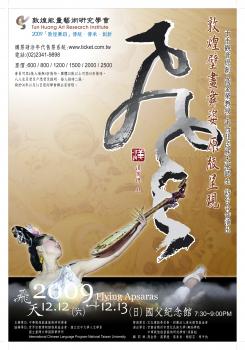
For more than five hundred years the Mogao Grottoes at Dunhuang were buried beneath the sands of the Gobi Desert. Since this veritable trove of Buddhist art was uncovered it has rightly attained its place as a central influence of Chinese art.
Artist Chang Ta-Chien (張大千) defended the caves from marauding tomb raiders and appropriated the rich Tang dynasty greens and cobalt blues from the caves. His lushly colored abstract landscapes are the primary mark of Dunhuang in contemporary Chinese art. Following in his footsteps, the inventive Flying Apsaras dance company found inspiration in Mogao’s deep aesthetic springs.
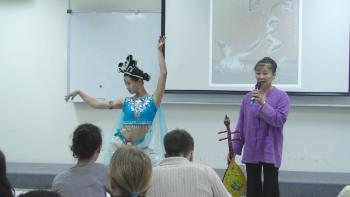
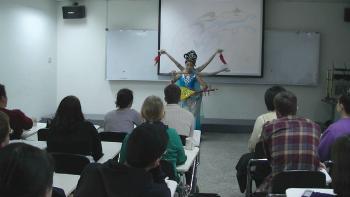
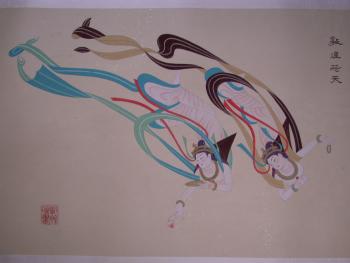
The Flying Apsaras dance troupe came to Taiwan on a rare visit to perform at Sun Yat-sen Memorial Hall and afforded ICLP students an opportunity to behold firsthand Chang’s worthy aesthetic inheritors. Adopting the curvaceous winged Buddhist spirits, known as flying apsaras, as its influence, the company has forged an entirely new dance milieu centered around the antiquated elegance of these figures, scrawled by the light of day as it lit Mogao’s caves through the miniscule entrances.
“Over the years the flying apsaras, which originated in India, were transformed from boxy stylized images, to the beautiful ideal aesthetic form of Tang dynasty art,” explained Kao Jinrong, professor at Northwest University of Nationalities in Gansu Province and director of the Flying Apsaras Dance Company. “We’ve striven to adopt this aesthetic and animate it through movement.”
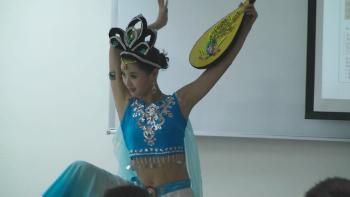
It’s a tall order, but the Flying Apsaras Dance Company delivers. With a clear grounding in ballet, the dancer’s legs soar, no doubt inspiring in ICLP students the same breathless feeling first felt by the patrons of Mogao’s caves, who sponsored the artwork to ensure their standing in the community and place in the afterlife. But more important than the dancers’ balance, Ms. Kao, a nurse who turned her attention to her passion for traditional culture and dance once she retired, stressed the breathing process as the mantelpiece of her technique. “It’s the breathing that centers the dancer. From the breathing comes all movement and most importantly the hand movements that signify the messages of the Buddha.”
Regardless of whether one recognizes the age-old iconography the dancers allude to, their flowing costumes and expert movements match to breathtaking effect their specially orchestrated music.