[Click here for video of the Wang Yeh boat procession leaving the temple's front gates moving toward the water where it will be burned.]
Any boat burning festival is essentially an exorcism, meant to dispel pestilence and bring healthy harvests, plentiful offspring, and good luck. As a student of Chinese religion, I had long hoped to experience the prolific contemporary religious culture of Southern Taiwan, and so jumped at the chance to witness the Wang Yeh Boat Burning Festival (燒王船) on October 10.
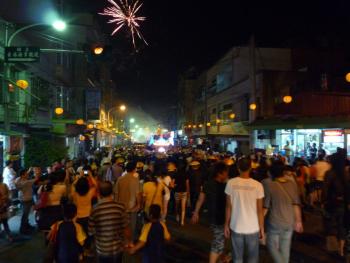
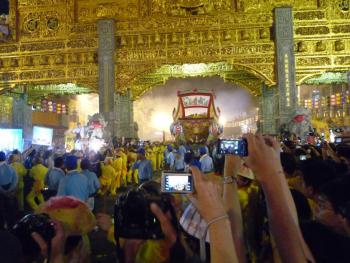
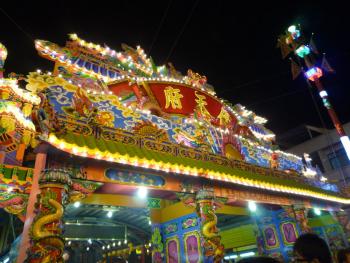
The triennial festival is held at Donglong Temple (東隆宮) in the port town of Donggang (東港鎮) in Pingtung County. The festival is complex and spans several weeks, but I was most interested in the multitude of rituals on the final day leading up to the 5:30 AM burning ceremony. Upon entering the temple’s courtyard, I was bombarded with a sensory overload—the smells of roasting meats, fish and pounds of burning incense, the colorful costumes, buildings, and palanquins embellished by neon lights, the sounds of ritual music and thousands upon thousands of people. Excitement was in the air! One would need hundreds of research assistants to truly understand the richness and complexity of the festival’s final day. As with any Taiwanese “popular religious”* festival it is less of an organized, systematic ritual (as with many orders of Buddhism), and more of a religious free-for-all wherein one might happen upon a group of Daoist priests in one corner of the courtyard, and ritual opera just outside of the temple gates. In fact, that is exactly what my experience was like.
Most scholars believe that boat burning ceremonies originate in the Song Dynasty (960-1279 C.E.); Donggang’s Wang Yeh ceremony has been a tradition for over 300 years, carried over from the mainland. Besides the Donglong Temple in Donggang, there are many other smaller temples dedicated to Wang Ye throughout Pingtung County. In fact, there are many gods considered “Wang Ye,” which is a term referring to “Royal Lords” who cover a great deal of ground in their battle against plague demons in the area. In other words, where there is plague and illness, there will be Wang Yeh temples.
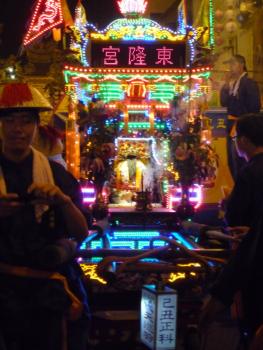
In one of the most exciting ceremonies I saw, troupes of male participants brought effigies of their temples’ respective deities to visit the Wang Ye and other lesser deities enshrined at Donglong. During the ceremony, deities control their troupes, sending them into a trance state. One can tell when someone is in a trance (some might call this possession) because the small palanquins which contain the deities begin bouncing up and down erratically. Sometimes this can be quite a scene as many of the palanquins are “blinged out” with neon lights, and thus a generator must follow the troupe (also carried by minor troupe members). Daoist priests converged at one point to perform their own ceremonies, gowns glistening in the lights of the surroundings.
In one instance, I noticed a troupe in trance, and quickly gathered my things to follow. Apparently the deity was not ready to enter the sacred space of the temple grounds, because after a few moments of intense struggle, the troupe with palanquin in tow, swung around, almost bowling over the onlookers (including yours truly). They swung around a second time, and headed back the way they came to try again later.
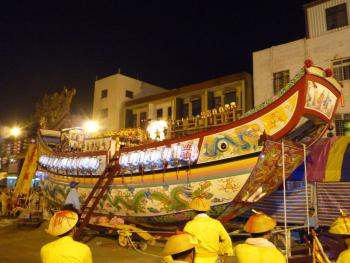
Finally, around 2:30am came the moment we all were waiting for: the boat began to move. Everyone was pushed out of the way as the lengthy procession began. I parked myself outside of the gates so that I could watch each troupe (they all wear different costumes and each palanquin is unique) follow the boat. I also wanted one, final look at the beautiful piece of art before it would be burned. The procession down to the water took hours. Every troupe had to follow the massive boat, and as the streets were filled with thousands of people—spectators, worshippers, tourists, vendors—the pace was very slow. Each troupe had its own unique formation, chants, and costumes, some even included women and children. It was wonderful to see entire families participating in rituals that are hundreds of years old.
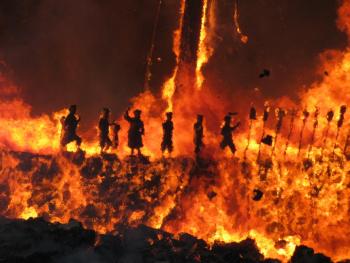
By the time the boat was situated atop a huge mountain of spirit money, and given the “okay” by the mediums in charge at the moment, it was 5:15 A.M. Everyone was exhausted. Fireworks were lit within the pile of money and the boat began to burn. I watched from a monitor with the majority of the spectators who (like me) did not want to fight our way to the front. The cool breeze from the water was much welcome at that point, and as the flames licked the body of the boat, I remembered the purpose of the ritual: to exorcise the area of plague demons. The fire grew larger by the moment. The rising sun tinted the sky pink and onlookers began to head home.
It’s not hard to see how burning a wooden boat would become a form of exorcism for plague demons if one considers the history of Southern China and yin-yang universal forces. Southern China today as well as in the past has a humid climate rife with disease-spreading potential, and as with crops infected with fungi or bacteria, or even a gangrenous limb, fire was the best way to destroy all traces of an epidemic. Why not use fire to affect the unseen spirit world as well? Moreover, according to tradition, illness within the body, and also in a large geographical area, is seen as an imbalance between yin and yang. When an individual falls ill, traditional Chinese doctors use herbal remedies to either remove or introduce yin or yang. Using fire, or yang, to burn away on a body of water, or yin, rebalances yin and yang.
With the tragic toll of the recent Typhoon Morakat and lingering fears over H1N1, one can surmise that the festival had particular significance this year. *Chinese “popular religion” is considered by most scholars to be neither Daoism, nor Buddhism, but something stemming from popular rituals and beliefs pre-dating standardized forms of religion. Of course, these rituals and belief systems (both standardized and not) incorporate and sometimes subsume each other, and thus is difficult to differentiate and unequivocally parse out. In recent years, contemporary scholars have pointed out that the term “popular religion” denotes inferiority to standardized religion, and thus even the term itself is up for debate. These systematic beliefs in the Taiwanese context also take on a unique manifestation.
Exorcising Plague Demons: The Wang Yeh Burning Boat Festival
 馮麗安
馮麗安
Anna-Alexandra Fodde-Reguer (美)