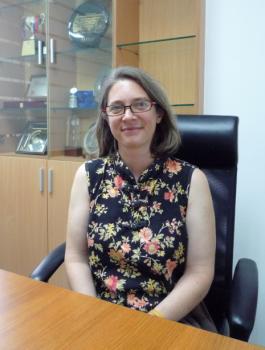
Humboldt State University Professor of Anthropology and ICLP (then IUP) alumna Mary Scoggin wasn’t sure how academia would figure into her future when she first arrived in Taipei as a nineteen-year-old. Then she found her “spark.”
“The encounter with China was a kind of a shock of recognition that literature wasn’t just literature, but rather it was politics and it was life.” In her graduate studies in Anthropology at the University of Chicago she further pursued the political significance of literature, eventually turning it into a dissertation on zawen (雜文, Chinese political essays). Drawing on fieldwork experience in Maoist China she writes, “zawen writers have been irony specialists in a period when any expression of social detachment and ambiguity can be a political act.”(1)
Participant observation is the most defining research tool of anthropologists. By spending an extended period of time in the field they are able to define and refine research questions and develop nuanced understandings of culture and society. What insights does this anthropologist have for students spending a semester or year immersed in Chinese culture?
“I don’t want to sound like Joseph Campbell and say ‘follow your bliss,’ but you need to find a kind of non-academic spark.” For Professor Scoggin that spark was the written word and its political deployment in society, although everyone must find his or her own inspiration. She cautions against only socializing with one’s classmates and isolating oneself from local society. “Go out and explore. I guess it’s a little bit of anthropology light. You need to go and walk and find different quarters of life. Somewhere in there you’re going to find that spark that works for you.”
As an undergraduate student at the University of Minnesota studied abroad in Nanjing. After graduating she studied at ICLP (then IUP), before studying under a professor at the NTU Department of Foreign Literature. Having done her formative language study in Taipei she remarks, “Like most scholars of China, I have a real fondness for Taiwan…There’s an intimacy to Taiwan that I really love.”
(1) p.148 “Wine in the Writing, Truth in the Rhetoric: Three Levels if Irony in a Chinese Essay Genre,” Scoggin, Mary. In Irony in Action: Anthropology, Practice and the Moral Imagination, Fernandez, James W., Huber, Mary Taylor eds.