|
A New Reason to Stay in Taiwan over New Years
Break:
ICLP Launches Home-Stay Program
Hsiang-Nien
Hsu /徐祥年 (美)
Traveling
during school breaks has long been a tradition for language students studying abroad, and
Chinese New Years has never been an exception-until now. Beginning in 2009,
ICLP students have a unique alternative to spending dollars abroad: they can
spend New Years with a local host family through ICLP’s New Years Home Stay
Program. Three ICLP students, Kara, Nate and Kendall spent their Chinese
New Year 2009 with different host families. They shared their experiences
with us here at the ICLP Bulletin.
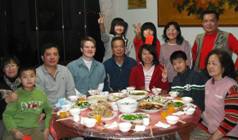
Chinese New year is a time for families to
come together, celebrate a new beginning and enjoy each other’s company.
Then there’s the food. From whole fish and chicken to eight-treasure
salad, from nian
gao to luo bo
gao, the ICLP students
got a full helping of traditional Chinese cuisine. Nate recalled that
the grapes he had during New Year’s dinner were picked from the local
vineyard and were “the largest and sweetest” he had ever eaten. Many of the foods
have significant meaning
due to how they are pronounced in Mandarin: oranges signify blessings and luck; fish signify wealth and abundance. Of
course, this abundance is meant to be shared, and Kara noted that her host
family was “extremely generous – they even gave me a hongbao!”
Aside from the sumptuous food, there were
plenty of entertainment options for our students. Ma-jong is a favorite
pastime of Kara’s host family, and Kara participated in the action during
New Years. “It can be quite intense, especially when money is involved,”
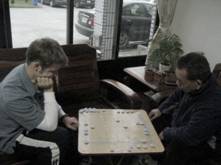
Kara said. She noted that she held own quite well despite being a novice. Kendall played
wei-qi with his
host-family’s head of the house. Deceptively simple, Wei-qi has
traditionally been the game of choice for Chinese scholars throughout
history due to its highly strategic nature.
Besides eating and playing games, a couple of
the students visited Daoist temples, which are scattered
throughout Taiwan. Locals often make
offerings of paper money, fruit, and other dishes to the spirits that
inhabit these temples
during the new year period. The goods offered are meant to help the
spirits live comfortably even in the afterlife: after all, everyone,
spirits included, could use an extra 1000 kuai or two.
The experience
complemented the students’
classroom learning, and gave them a first-hand view of how a traditional
Chinese family celebrates the coming of the New Year. “I highly recommend the experience,” Kendall said. “My host family was
extremely hospitable and we all had lots of fun.” Nate concurred, but
warned future students that they should be ready to field a variety of
questions regarding their own country and culture: “I was a little
unprepared for how much of a representative of American culture and thought
I was expected to be. By which I mean the family was continuously asking
questions that ranged from when Americans typically brush their teeth to
our response to political corruption, and everything in between. This
definitely was a two-way cultural exchange.”
ICLP’s
New Year Stay at Home program will likely be expanded in the future to give
even more students an opportunity to experience and celebrate this
important cultural event firsthand.
下一篇文章
|