|
  2009 ICLP
Annual Mazu
Pilgrimage 2009 ICLP
Annual Mazu
Pilgrimage
Kendall Smith, on assignment
As legend has it, in 960 AD Lin Moniang (林默娘) was born as the seventh daughter to Lin Yuan of Fujian Province. How exactly Moniang the mortal woman
became Mazu, patron goddess of seafaring people,
is open to scholarly interpretation.
In any case, Mazu is today one of the most
revered popular deities for Chinese-speaking peoples in East and South East Asia.
On April 15, ICLP students, teachers, and staff traveled to Beigang (北港) for the rare opportunity to see Mazu celebrated during the annual “Mazu Processsion” (北港媽祖繞境), a spectacular display of vibrant colors, vigorous spirit and spiritual dedication.
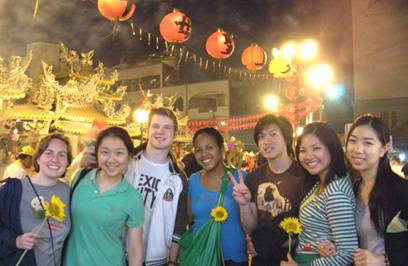 To witness Mazu’s
birthday celebration is to experience many sights, sounds, and smells that
are difficult to describe in words or even capture on film. Imagine the feeling of bits fireworks felt ricocheting off your
clothing. The air is thick with incense. A
brightly-lit procession of Mazu Floats (花車) passes by and the children aboard toss candy to eager onlookers. To witness Mazu’s
birthday celebration is to experience many sights, sounds, and smells that
are difficult to describe in words or even capture on film. Imagine the feeling of bits fireworks felt ricocheting off your
clothing. The air is thick with incense. A
brightly-lit procession of Mazu Floats (花車) passes by and the children aboard toss candy to eager onlookers.
The Mazu pilgrimage was only one leg of ICLP’s
three-day journey through Central Taiwan.
Earlier on April 15, we made our
first stop at Dajia’s Cake Shop (裕珍馨) where we learned to make our own Chinese pastries. As our cakes baked, we learned more about local traditions on a
tour of the cake store’s folk arts museum (大甲三寶文化館). Students were invited to try on
traditional wedding clothing and admire the elaborately embroidered
costumes used in the Mazu Procession. Later in the afternoon ICLP visited
several sites of historical and cultural interest in Lugang
(鹿港).
These included Longshan Temple and (龍山寺) Tianhou Temple (天后宮),
among others.
The second day was just as full of
activities. ICLP visited a tea field
owned by National Taiwan University (鹿谷鳳凰茶園自然教育園區) in the mountain village of Lugu (鹿谷) and learned how hand-picked tea
leaves are processed for sale and consumption. We also learned how the tradition of cultivating
oolong tea traveled from Fujian province to Taiwan.
Later we visited a museum that was once a timber mill and sampled
plum wine at a distillery in Checheng (車埕). Here
those of legal age enjoyed a variety of complementary spirits, while others
were engrossed in a game of “big two” (大老二). The day ended with a wet
and rainy yet ever majestic boat tour of scenic Sun Moon Lake (日月潭) and surrounding sites of interest.
|