|
 An Interview with Dir. Leung An Interview with Dir. Leung
Bryan K. Beaudoin
The ICLP
Bulletin sat down with ICLP Director Dr. Leung Yanwing (梁欣榮).
BKB:
You’ve been following ICLP’s progress since starting your first
directorship years ago. Where do
the program’s strengths lie?
Leung:
Looking at the program today I really have to take my hat off to
the American founders of forty-five years ago. It was their formula of small class
sizes and emphasis on speaking that is the key to our success. ICLP has
been called one of the world’s elite Chinese language programs.
With the rise of China there has been a
huge increase of interest in Chinese.
In the past a great advantage of studying in Taiwan was the
relatively free political atmosphere.
Mainland Chinese language textbooks were heavily censored, and
foreign students had to report any contact with local students. Much has improved.
Because of competition from profit-driven
schools, it’s difficult for even the best Mainland Chinese language
programs to retain teachers for more than a year or two. In contrast, when I started, the
average ICLP teacher had 17 years of experience. Today some have upwards of thirty. There’s just nothing like this kind of
dedication anywhere else. We’re
certainly not in it for the money! [laughs] Significantly, the maturity of ICLP’s
pedagogy means that students enjoy a tried-and-true curriculum under
which each course builds upon the last.
(continued)
|
When
Spring is in the Air,
One
Plus One Equals King
Bryan K. Beaudoin
[Feb. 09] When does one plus one
equal king? With a hint of Spring
in the air, ICLP celebrated the fifteenth day of the new lunar year known
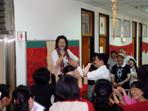
as Lantern festival or Yuanxiaojie (元宵節). At noon students and teachers filled
the halls to enjoy seasonal foods and compete in a lantern riddle contest
(猜燈謎大賽).
Teacher Chu-hua Huang (黃琡華) hosted the lantern riddle contest. Teachers dressed in red and white led
recruited students to their own teams.
To crack a Chinese character riddle (字謎), one must guess a single character based
on a cryptic hint and knowledge of character structure, pronunciation,
and of course the individual’s ingenuity and a little luck. For instance, 一加一 (one plus one), would not be 二 (two), but rather 王 (king), which resembles a + sandwiched
between two 一’s.
Students vied for prizes
including flash drives and CDs.
When these were gone the losing team performed stunts. Teachers Chih-cheng Hsu (徐志成) and Yi-hsian He (何怡嫻) writing 元宵 (yuanxiao) with their
posteriors. No easy feat!
Also offered was the traditional treat
of the holiday, yuanxiao, sticky rice balls stuffed with peanut or black
sesame sauces.
|