|

Helping the Blind One Shengci at a
Time
 Bryan K. Beaudoin Bryan K. Beaudoin
[Jan. 19] ICLP
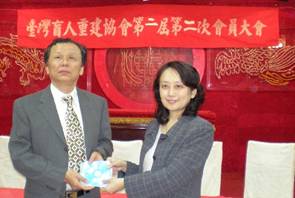
teacher Wan-Hong Jiang (江宛鴻) presented a set
of audio English learning materials for masseuses at a meeting of the
Association for the Blind of Taiwan (台灣盲人重建協會). In response to the growing need of masseuses
to communicate with foreign clients, Jiang and
ICLP students volunteered their time and energy to create an audio course
for massage-related English and Japanese.
Accepting a
package of CDs, director Huei-Hsing Huang (黃輝星) expressed his
thanks to Jiang and student volunteers, as well
as to ICLP for its institutional support. Established in 2003, the association
helps the blind find employment and improve their children’s educational
opportunities.
Jiang first
noticed the particular need of blind masseuses when teaching English to
blind students several years ago. “With the recent economic downturn and
internationalization of Taipei, it’s
become more important for blind masseuses to expand their market to include
foreign customers,” she explained. Under Jiang’s
guidance ICLP students Kathlene Baldanza, Kobin Kendrik, Jonathan Ying, and Akiko Hachisuka
collaborated to design and record the materials.
Both Huang and Jiang noted the blind community’s continuing need for
volunteers. In particular, blind parents often have difficulty helping
their children with homework. Huang and Jiang
called on ICLP’s active student body to reach
out.
|